
… Usually the second one.
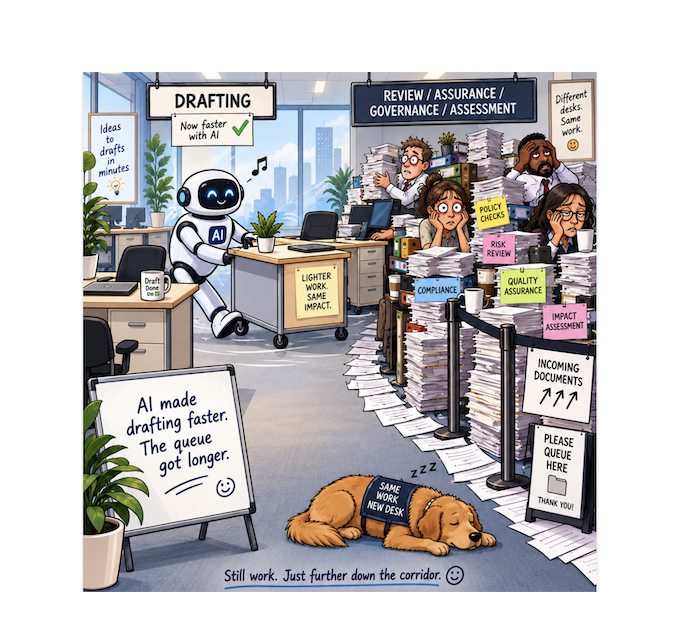
The pitch is that AI cuts the cost of building online learning content. What actually happens is that the cost changes owner.
Drafting gets cheaper. Everything downstream gets more expensive. Review, because more material arrives faster and someone still has to read it properly. Assurance, because plausible-but-wrong now looks exactly like correct. Provenance, because you need to know where a claim came from and whether you hold the rights to use it. Governance, because someone has to own the standard and apply it across a much larger volume of output.
In higher education, that lands somewhere specific. We already have the review desk. Module leaders, validation panels, external examiners, PSRB sign-off. That machinery predates AI, it is already full, and it runs on the time of academics who are the scarcest input in the institution. Push twice the draft material into it and you don’t get a saving. You get a queue.
Then assessment, where the cost goes up rather than down. HEPI’s Student Generative AI Survey 2026 (Report 199, Stephenson and Armstrong, sponsored by Kortext) found 94% of full-time UK undergraduates using generative AI to support assessed work, and 95% using AI in some form. The equivalent assessment figure was 88% in 2025 and 53% in 2024. QAA’s position is that the answer isn’t detection, it’s principled redesign. And there is a live argument in the sector, set out on the HEPI blog in July, that the OfS should make AI assessment policy an auditable condition of registration and that QAA should require a minimum proportion of assessment that is demonstrably non-delegable. That is commentary, not policy. But if any of it firms up, assessment redesign stops being a workstream someone gets to next year and becomes a funded line.
If you’d rather have that from a regulator than from me, read the SRA’s warning notice on the misuse of AI, published in August 2026. Different sector, identical logic. It states plainly that AI has no separate legal personality, that professional accountability does not transfer to the tool, that supervisors remain answerable for work produced under them, and that firms need effective governance structures, systems and controls. It also warns against entering confidential material into AI tools without proper contractual, technical and organisational safeguards. Swap “client” for “student” and much of it reads like a data protection policy you already have. And if you deliver SQE preparation, this isn’t an analogy. It applies to you directly.
None of this makes AI a bad bet for content build. Faster cycles, more iterations, better coverage, wider accessibility, academic time redirected to the work that actually needs academic judgement. Those gains are real.
But they are a different business case from the one being written. The ones that fail book the drafting saving in year one and leave the offset unfunded. They don’t fail at the pitch. They fail at the build gate, when the review queue turns out to be real and nobody staffed it.
If you’re modelling AI savings on content, model where the work went.
Sources
SRA, Misuse of AI (warning notice, 17 August 2026): https://www.sra.org.uk/solicitors/guidance/misuse-ai/
HEPI, Student Generative Artificial Intelligence Survey 2026 (Report 199): https://www.hepi.ac.uk/reports/student-generative-ai-survey-2026/
QAA, advice and resources on generative AI: https://www.qaa.ac.uk/sector-resources/generative-artificial-intelligence/qaa-advice-and-resources
HEPI blog, ‘Verifiable judgment: what AI actually demands of universities’ (14 July 2026): https://www.hepi.ac.uk/2026/07/14/verifiable-judgment-what-ai-actually-demands-of-universities/

